 EN
EN

Selecting the Right Heat Exchange Unit for Industrial Air Handling Units
For facility managers and HVAC engineers, the heat exchange unit is a critical component of an industrial Air Handling Unit. It is the part of the system responsible for recovering thermal energy from the exhaust air and transferring it to the incoming fresh air. This process of energy recovery dramatically reduces the load on the heating and cooling equipment, leading to significant operational cost savings. However, selecting the right heat exchange unit is not a one-size-fits-all decision. The choice between a plate exchanger, a finned-tube coil, or a rotary thermal wheel involves a careful trade-off between thermal efficiency, physical footprint, and resilience to the specific conditions of the industrial environment. Understanding the operational principles and application boundaries of each type is essential for making an informed investment that delivers long-term value.
Understanding Plate Heat Exchangers
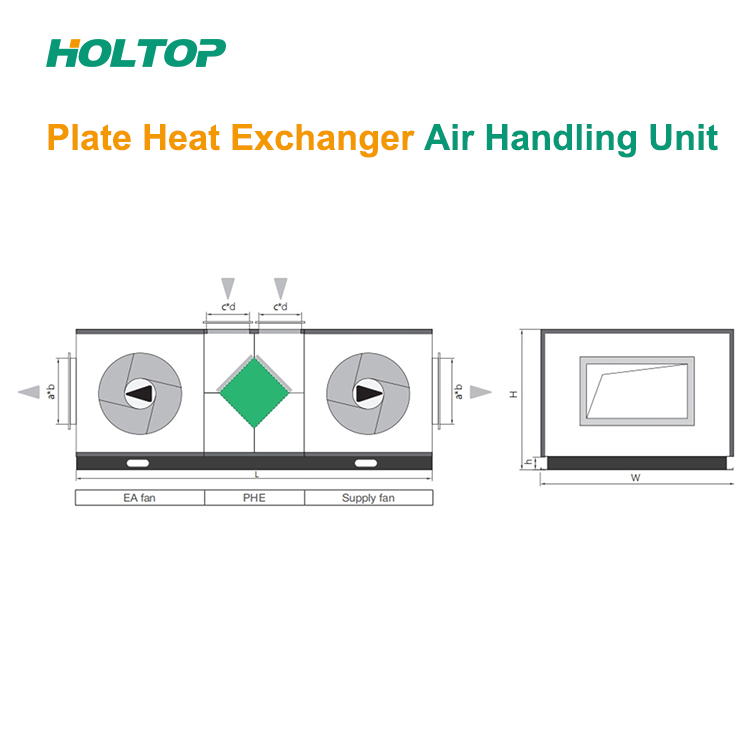
Plate heat exchangers are designed for sensible energy transfer. They consist of a series of thin, corrugated metal plates that are stacked together. These plates create alternating channels for the exhaust and supply airstreams. As the two streams flow past each other, thermal energy conducts through the metal plates from the warmer side to the cooler side, without the airstreams ever mixing. This fixed-plate architecture offers significant advantages. Because there are no moving parts, the system requires minimal maintenance. The compact, modular design allows for high thermal efficiency in a relatively small footprint, making these units ideal for retrofitting into existing AHU cabinets. However, the efficiency of a plate heat exchanger is closely tied to the cleanliness of the airstreams. The narrow channels between the plates are susceptible to fouling in environments with dust, fibers, or grease. Therefore, mechanical pre-filtration is mandatory. This filtration adds pressure drop, which must be factored into the fan energy calculations. In colder climates, frost formation is another critical design consideration, potentially requiring bypass dampers or cyclic defrost strategies. The core value proposition of the plate heat exchanger lies in absolute airflow separation, making it the definitive choice where cross-contamination is unacceptable, such as in pharmaceutical or chemical processing facilities.
Finned-Tube Units for Harsh Conditions
Finned-tube heat exchange units represent a different engineering philosophy. These systems prioritize ruggedness and cleanability over extreme compactness. They consist of copper or aluminum tubes that are mechanically bonded to a dense array of fins, forming a coil. A heat transfer fluid, such as a water-glycol mixture, circulates through the tubes. The run-around loop design decouples the exhaust and supply ducts physically, which allows the recovery coil in the exhaust stream to be installed at a distance from the reheat coil in the supply stream. This geometry is especially advantageous for retrofits where the supply and exhaust ducts are not adjacent. The industrial robustness of finned-tube units stems from their material flexibility and serviceability. For corrosive exhaust streams, the coil construction can be upgraded to stainless steel or epoxy-coated surfaces. Fin spacing can also be widened to mitigate particulate buildup. These units are sensible-only devices, meaning they transfer temperature but not moisture. This makes them a sound choice for high-temperature, dirty exhaust streams where regular high-pressure washing is required, and where accepting a modest reduction in thermal ratio is justified by long-term reliability.
Rotary Heat Exchangers for Total Energy Recovery
Air-to-air rotary heat exchangers, often referred to as thermal wheels, offer a capability that plate and finned-tube units cannot provide: the recovery of latent energy, or moisture. The wheel is a rotating cylinder filled with a desiccant-coated media. As the wheel slowly rotates between the exhaust and supply airstreams, it absorbs moisture from the more humid stream and releases it into the drier stream. This process allows the system to manage both temperature and humidity simultaneously. A properly specified thermal wheel can achieve high total effectiveness, significantly reducing peak cooling loads in hot, humid climates. However, the rotary design introduces a unique challenge: controlled leakage. As the wheel rotates, a small amount of exhaust air is inevitably carried over into the supply airstream. A purge sector is used to minimize this cross-contamination, but a carryover rate is physically unavoidable. This inherent trace mixing renders thermal wheels unsuitable for applications involving toxic fumes, pathogens, or heavy odors. The drive motor for the wheel consumes continuous energy, and the desiccant media requires periodic cleaning to preserve its sorption capacity. The selection of a thermal wheel depends on the specific process requirements. A data center with high sensible heat and negligible latent load is better served by an air-to-air plate unit, whereas a food processing plant requiring precise humidity control for drying operations benefits strongly from a thermal wheel.
Balancing Efficiency with Pressure Drop
One of the most critical trade-offs in selecting a heat exchange unit is balancing thermal efficiency against pressure drop. The geometry of the unit that improves heat transfer often also increases the resistance to airflow. Tighter fin spacing or complex flow paths boost thermal efficiency but disproportionately raise resistance, especially at higher velocities. Since fan energy can account for a significant portion of an AHU's total lifecycle cost, a unit with slightly higher thermal efficiency becomes uneconomical if it substantially increases static pressure. Modern designs mitigate this issue by using asymmetrical plate spacing or smooth, laminar-flow channels to reduce turbulence. For Variable Air Volume systems, the performance of the heat exchange unit shifts dramatically at low loads. If the face velocity falls outside the optimal design range, the recovery efficiency can drop significantly. The most effective solution is a unit with a broad, flat efficiency curve that maintains high recovery whether the AHU runs at full capacity or at a reduced load.
The Importance of Fouling Resistance and Cleanability
In an industrial setting, the long-term performance of a heat exchange unit is heavily dependent on its resistance to fouling and the ease with which it can be cleaned. A heat exchange unit processing particulate-laden air can lose a significant portion of its thermal effectiveness within months due to a fouling layer. This degradation increases pressure drop, forcing the fans to work harder and eroding the initial energy savings. Selection criteria must therefore emphasize structural resilience, not just initial efficiency ratings. Flat-plate exchangers offer a distinct advantage here because their smooth, uninterrupted surfaces provide fewer anchor points for dust and oily residues. Designs that enable full plate extraction without disrupting the ductwork can reduce annual service time considerably. In sectors like pharmaceutical or food processing, where hygiene is non-negotiable, the ability to integrate the unit into a Clean-In-Place system is decisive.
Retrofit-Friendly Modular Designs
One of the most common challenges in upgrading an industrial AHU is integrating the new heat exchange unit into the existing plant footprint. Modern retrofit strategies solve this with modular designs that fit within the existing mechanical spaces. A plate-and-shell heat exchange unit encases a stack of corrugated plates inside a cylindrical pressure vessel, creating a self-contained module that bolts directly into the piping network. This design uses water or glycol as an intermediate heat transfer fluid, fully isolating the exhaust and supply airstreams. Its compact footprint often fits within standard mechanical rooms. Alternatively, a compact finned-coil solution is a drop-in cassette that slides into the existing AHU casing on a rail system. Installation is rapid, often allowing a single section to be swapped out during a planned shutdown. This modular approach allows facilities to incrementally upgrade their heat recovery capacity across budget cycles, transforming a major plant overhaul into a scheduled maintenance task.
How Quality Manufacturing Ensures Long-Term Reliability
The long-term performance of a heat exchange unit depends on the quality of its manufacturing. The integrity of the plate seals, the precision of the fin bonding, and the durability of the desiccant coating all contribute to the system's ability to maintain its recovery efficiency. Manufacturers who adhere to recognized quality standards, such as ISO 9001, subject their units to rigorous pressure and leak testing before they leave the factory. For a facility manager who is investing in an AHU upgrade to generate long-term energy savings, partnering with a disciplined, quality-focused manufacturer provides the ultimate confidence that the equipment will perform reliably for years.