 EN
EN

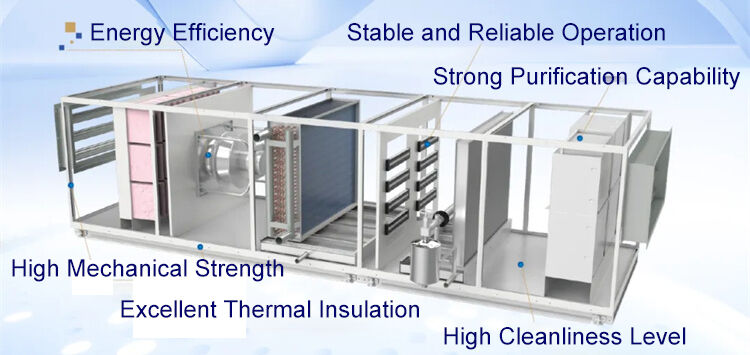
Core Principles of AHU Temperature and Humidity Control
How Heating/Cooling Coils Regulate Air Temperature with Setpoint Accuracy
The main way to control temperature sensibly in air handling units (AHUs) comes through heating and cooling coils. When chilled water runs through these coils, it cools down the supply air below the dew point which helps get rid of moisture at the same time. Hot water or steam coils work differently by adding controlled amounts of heat to the air stream. Today's modern systems can maintain discharge air temperatures within about half a degree Celsius thanks to those fancy closed loop PID controllers. These controllers constantly adjust where the valves open based on what sensors report back in real time. The whole system adapts well to changing conditions like when people move around spaces or when outside weather changes suddenly. Special thermal breaks made usually from polyamide material between different parts of the coil stop unwanted heat movement. This is really important for keeping temperatures stable in places like labs and cleanrooms where even small variations matter a lot.
Fundamentals of Moisture Removal: Condensational Dehumidification vs. Active Humidification
Humidity control operates through two complementary mechanisms:
- Condensational dehumidification, where cooling coils reduce air temperature below its dew point, causing moisture to condense on coil surfaces and drain away. This process dominates in high-latent-load environments like tropical climates.
- Active humidification, which introduces steam or atomized water via dispersion tubes when indoor relative humidity (RH) falls below the target—common in winter or arid conditions.
Getting the balance just right matters a lot. When dehumidification coils are too big, they end up needing way too much reheating energy. On the flip side, if humidifiers aren't sized properly for the space, they simply can't keep relative humidity above minimum levels when dealing with those cold, dry conditions we often see. Good system design really needs proper latent load calculations to figure out what mix works best for keeping RH stable within about plus or minus 5 percent. And don't forget about drain pans either. They need to slope correctly according to ASHRAE Guideline 18 standards. Plus coating them with something antimicrobial helps prevent all sorts of nasty microbes from growing during those condensation cycles that happen so frequently in these systems.
Advanced AHU Components for Reliable AHU Temperature Humidity Control
Desiccant Dehumidifiers and Steam Humidifiers in Low- and High-RH Critical Zones
Desiccant dehumidifiers work by chemically pulling moisture from the air, which allows them to maintain humidity levels below 5% RH in areas that need ultra low humidity, like semiconductor manufacturing facilities. These places require such dry conditions because even small amounts of moisture can cause electrostatic discharge problems that damage sensitive equipment. On the other hand, pharmaceutical cleanrooms typically use steam humidifiers instead. These devices release clean vapor without particles to keep humidity stable within half a percent RH. This helps prevent products from absorbing moisture and breaking down over time. Many modern installations include what are called enthalpy recovery wheels in both types of systems. These components help save energy costs by around 25 to 40 percent compared to older models. Good control over moisture levels is especially important when dealing with air handling units that operate at different temperatures. Proper management prevents condensation issues that could otherwise disrupt production processes and compromise product quality throughout various manufacturing stages.
Thermal Break Design and Condensation Prevention in Dual-Temperature AHU Sections
Thermal break materials like structural polyamide barriers help keep warm and cold air streams separate inside air handling units. According to recent ASHRAE research, around 74 percent of contamination problems in facilities actually come from microbes growing because of condensation issues. When thermal breaks are properly designed, they stop thermal bridging and maintain temperature differences above 30 degrees Celsius without causing condensation on surfaces. These special barriers cut down on energy losses related to condensation by somewhere between 15 and 22 percent each year. Other important steps include installing insulated access panels and making sure there are continuous vapor barriers throughout the system. Together these methods protect internal parts from getting wet in places where humidity levels tend to be really high during normal operations.
Integration, Automation, and Real-World Performance Validation
BAS Integration: Closed-Loop Feedback, PID Tuning, and Sensor Calibration Best Practices
Getting good temperature and humidity control from air handling units really depends on having a solid building automation system in place. The closed loop feedback system keeps checking what the sensors are measuring against the target values, which makes the system automatically adjust valves, dampers, and humidifiers when needed. PID tuning helps get those adjustments right so the system responds quickly without going too far or bouncing around too much. This is super important in places like pharmaceutical labs where even small temperature changes of plus or minus half a degree can ruin entire batches of products. We recommend doing annual calibrations using NIST traceable standards to keep sensors accurate because drifting readings are one of the main reasons these systems fail. Most problems come from sensors that haven't been properly maintained over time. For critical areas, install backup sensors, set up automatic diagnostics to catch issues early, and test out all the control logic with different load scenarios before putting everything into operation.
Case Evidence: Lab AHU Failure Analysis (±0.3°C Drift — Process Deviation)
A biotech facility experienced repeated batch rejections linked to a persistent ±0.3°C temperature drift in its lab AHU. Root-cause analysis identified corroded humidity sensors and poorly tuned PID loops—both contributing to ductwork condensation and airflow disruption. The $220,000 remediation included:
- Replacing all humidity and temperature sensors with NIST-traceable units,
- Retuning control parameters using real-world occupancy and load profiles,
- Adding dew point monitoring to proactively manage condensation risk.
Post-intervention, temperature stability improved to ±0.1°C, eliminating process deviations and associated batch losses—demonstrating how seemingly minor calibration or tuning lapses can cascade into measurable operational and financial impact.
Common Limitations and Proven Troubleshooting Pathways for AHU Temperature Humidity Control
Well designed AHU systems still run into problems all the time. The sensors tend to drift about half a degree Celsius or five percent relative humidity over time. Coil fouling is another big issue that can cut down on heat transfer efficiency by nearly thirty percent. And then there's the whole problem with managing dew points properly. Controlling humidity remains a real headache for many operators. According to industry data from ASHRAE, roughly two thirds of building managers find it tough to keep those tight RH ranges without paying through the nose in extra energy costs. It's just one of those ongoing battles in HVAC maintenance.
Good troubleshooting always starts with proper calibration and regular inspections. Critical sensors should be checked against NIST-traceable standards about every three months, while thermal breaks need annual checks to ensure they're still holding up. When dealing with humidity problems, don't jump straight to changing control settings. First check if the mechanical parts are working right - look at whether steam humidifier nozzles are clean or if desiccant wheels are spinning at the correct speed. The building automation system's trend logs can actually spot PID loop oscillations, which cause roughly 42 percent of control issues. If problems keep happening after these steps, it makes sense to test different parts of the air handling unit separately. Test heating, cooling, and humidification components individually to find out where faulty valves, dampers, or actuators might be hiding. Regular preventive work matters too. Cleaning coils and replacing filters every few months stops about 80 percent of unnecessary performance drops. Buildings that follow this kind of systematic approach typically see around 57 percent fewer environmental problems and their equipment lasts much longer before needing replacement.
FAQ
What are the main components of an AHU for temperature and humidity control?
AHUs utilize heating and cooling coils to regulate air temperature, while condensation and humidification mechanisms manage humidity. Advanced components include desiccant dehumidifiers, steam humidifiers, and enthalpy recovery wheels.
How do thermal break materials contribute to AHU efficiency?
Thermal break materials, like polyamide barriers, prevent unwanted heat exchange within the AHUs, thus maintaining internal temperature differences without causing condensation, reducing contaminant risk, and minimizing energy loss.
Why is proper calibration of sensors crucial for AHU performance?
Proper sensor calibration ensures accurate temperature and humidity control. Drift in sensor readings can lead to inefficient system performance, affecting product quality and increasing operational costs.
What are common AHU operational issues and how can they be addressed?
Common issues include sensor drift, coil fouling, and humidity control challenges. These can be addressed through routine calibration, inspections, cleaning, and system adjustments based on trend log analysis.