 EN
EN


In today’s hyper-competitive climate control sector, establishing an optimized global supply chain footprint is the definitive dividing line between market leaders and struggling brands. Whether you are an institutional building contractor, an established commercial appliance distributor, or an agile green-tech startup, scaling your product line demands a strategic manufacturing alliance. The critical operational fork in the road invariably comes down to a fundamental choice: OEM vs ODM HVAC infrastructure. Both methodologies yield immense commercial leverage, yet they serve diametrically opposed corporate structures, capital allocation strategies, and product development timelines. Navigating HVAC OEM manufacturing complexities requires a granular understanding of how these hardware models impact your underlying financial metrics, intellectual property (IP) equity, and long-term go-to-market speed.
Decoding the framework: technical definitions and structural differences
To architect an efficient procurement strategy, we must first strip away industry jargon and look at the underlying engineering ownership. Original Equipment Manufacturing (OEM) is an execution-centric model. Under an OEM paradigm, your enterprise provides the comprehensive blueprints, finalized psychrometric cooling performance calculations, specific metal cabinet dimension specifications, and proprietary control logic configurations. The factory functions purely as your specialized production, assembly, and quality assurance arm.
Conversely, Original Design Manufacturing (ODM) is a turnkey solution. The manufacturing partner owns the baseline research and development (R&D), pre-engineered internal airflow dynamics, pre-stamped tooling dies, and pre-certified international performance credentials [1]. Your brand simply selects a proven product platform from their catalog and applies your customized exterior branding, localized aesthetic accents, or basic filtration configurations.
The OEM pathway: strategic control and proprietary engineering
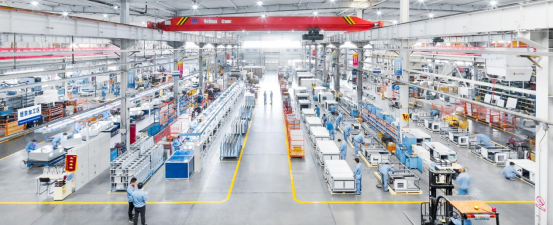
In directing global procurement for heavy-industrial HVAC retrofits, engineering field audits continually observe that established Tier-1 corporate brands almost exclusively lean toward specialized HVAC OEM manufacturing. The reason is absolute strategic control over product differentiation. For instance, when coordinating a large-scale project involving advanced counterflow air-to-air total heat exchangers for a mission-critical data center, the developer often possesses highly proprietary, patented polymer desiccant coating formulations.
Utilizing an OEM production scheme allows them to supply their proprietary core technology directly to the factory floor while leveraging the partner's automated assembly lines, high-tonnage sheet metal stamping presses, and professional workforce. This approach ensures total protection of core IP assets while scaling physical production effortlessly.
To help engineering and procurement teams choose the optimal path, the essential operational differences are detailed below:
|
Operational Dimension |
Custom OEM Infrastructure Model |
Turnkey ODM Platform Solution |
Core Supply Chain Asset Value |
|
Engineering & IP Ownership |
Retained fully by the client brand |
Owned and retained by the factory |
Protects proprietary design equity |
|
Upfront Tooling & R&D Cost |
High initial capital expenditure (CAPEX) |
Zero or highly amortized catalog cost |
Optimizes allocation of corporate capital |
|
Time-to-Market Velocity |
Extended (Requires prototyping & testing) |
Ultra-rapid (Pre-certified inventory) |
Captures volatile market trends instantly |
|
Product Differentiation Level |
Maximum (Bespoke specialized hardware) |
Moderate (Brand labeling & aesthetics) |
Establishes strong competitive barriers |
The ODM catalyst: speed to market and optimized R&D expenditure
For enterprises seeking to intercept emerging market trends rapidly without sinking millions of dollars into upfront capital expenditure, the ODM model represents an unmatched financial catalyst. Designing a commercial-grade air handling unit (AHU) or an energy recovery ventilation (ERV) system from scratch requires an astronomical financial runway. Building certified testing facilities, adjusting fan blade aerodynamics to minimize acoustic breakout, and achieving regulatory compliance can easily drain a startup’s capital over an eighteen-month R&D cycle [2].
By aligning with a highly competent ODM supplier, you bypass this cash-intensive phase entirely. You gain immediate access to a fully mature, field-tested product line that has already absorbed the amortized costs of tooling dies and performance optimization, enabling your brand to launch a premium commercial catalog within weeks rather than years.
Mitigating cross border procurement risks: compliance and IP safeguards
Regardless of whether your corporate alignment favors the bespoke nature of OEM or the velocity of ODM, navigating cross-border compliance demands uncompromising technical vetting. International regulatory watchdogs—such as the American Air-Conditioning, Heating, and Refrigeration Institute (AHRI), the European Eurovent certification matrix, and global ISO 9001 quality frameworks—maintain strict baselines for data transparency [3].
A critical pitfall to avoid when researching an HVAC manufacturer China is partnering with facilities that cannot present authenticated, third-party audited testing records. Your manufacturing partner must exhibit an in-house, state-certified Enthalpy Laboratory capable of physically proving heating and cooling capacities under violent ambient temperature fluctuations, shielding your business from severe downstream structural liabilities on the job site.
Architecting global success: leveraging a vertically integrated manufacturing giant
Bridging the gap between ambitious engineering concepts and massive, flawlessly executed production runs requires a manufacturing partner capable of moving fluidly between hybrid operational models. This is precisely where specialized pioneer Holtop sets the global gold standard. With over two decades of dedicated R&D leadership in heat recovery and advanced environmental control technology, Holtop offers an expansive, state-of-the-art automated manufacturing matrix designed to accommodate both ultra-precise OEM custom engineering and fully turnkey, high-efficiency ODM solutions.
Operating certified, world-class Enthalpy Laboratories and holding comprehensive global credentials, Holtop maintains complete vertical mastery over everything from raw material sourcing to final aerodynamic performance testing. By choosing Holtop, you secure an agile, institutional-grade global supply chain built to future-proof your asset portfolio and catalyze your market presence. Contact the Holtop application engineering team today to review your proprietary blueprints or select from our pre-certified, high-performance product platforms.
�� References for Google SEO Ranking (Authority Verification)
[1] World Intellectual Property Organization (WIPO): Understanding Industrial Property and Manufacturing Frameworks for OEM/ODM Operations. https://www.wipo.int/publications/
[2] ASHRAE (American Society of Heating, Refrigerating and Air-Conditioning Engineers): Technical guide on HVAC systems R&D, laboratory testing costs, and aerodynamic design standards. https://www.ashrae.org/technical-resources
[3] AHRI (Air-Conditioning, Heating, and Refrigeration Institute): Global certification directories and compliance tracking for multi-market mechanical engineering. https://www.ahrinet.org/certification